
Learning About Art
Learn more about art, artists, art styles, and more
Buy Original Art from The Fine Art Hut
Art History
Learning about art inevitably involves understanding something about the history of art.
Below we have put together a general overview of art history. We trust the information will help you have a better understanding and appreciation for art.
An Introduction to Art
Art has been part of human life for tens of thousands of years. From the earliest cave paintings to digital installations today, art tells the story of who we are, how we think, and what we believe.
Art is more than just paintings in a museum or sculptures in a park—it’s a visual record of what it means to be human. Every culture, in every era, has used art to express beliefs, tell stories, record history, challenge authority, celebrate beauty, and explore the unknown. From the first cave drawings made by firelight to today’s digital masterpieces shared around the globe in seconds, art has always been at the heart of human experience.
The history of art is, in many ways, the history of us. It's how we see the world and how we want the world to see us. Through art, we can glimpse the minds of people long gone, understand the struggles and dreams of different societies, and explore how styles, ideas, and techniques have evolved over time. Whether it’s a religious icon, a political mural, or a quiet landscape painting, every piece of art offers insight into the time and place it came from.
This overview will guide you through some of the major movements and styles that shaped the world of art.
Whether you're looking to deepen your appreciation, start creating your own art, or simply understand why certain works are considered masterpieces, studying the history of art is a meaningful and enriching adventure. It’s a window into culture, identity, innovation, and imagination—and it’s open to everyone.
Art Movements
Dive into the timeline of creativity. From the earliest symbols scratched into stone to contemporary works challenging the digital age—each era has something to reveal.
Prehistoric Art (c. 40,000–3000 BCE)
Prehistoric art marks the very beginning of art history—before written language, organized society, or recorded civilization. Created by early humans tens of thousands of years ago, this art gives us rare and powerful glimpses into how our ancestors saw the world. It reflects their beliefs, survival needs, and growing sense of identity and culture.
These peoples used natural materials to create their art, such as, stone, charcoal, ochre (red or yellow pigment), bone, ivory, and clay.
They often depicted animals, handprints, human figures and fertility icons.
Many famous caves and rock shelters still illustrate prehistoric man's artworks including:- the Lascaux Cave in France.
Prehistoric art represents humanity’s first steps toward symbolic thinking, storytelling, and cultural identity.

Ancient Art (c. 3000 BCE–500 CE)
As humans transitioned from nomadic lifestyles to settled societies, the art they created became more organized, symbolic, and tied to complex beliefs and social structures.
Ancient art emerged alongside the first great civilizations—Egypt, Mesopotamia, Greece, Rome, China, India, and Mesoamerica—each leaving behind distinct styles and monumental works that continue to shape art today.
Some of the characteristics of art during this period included religious and political art forms to honour gods, commemorate rulers, and express cultural values.
Materials often used were stone, bronze, gold, clay and wood with artworks taking various forms, such as: sculpture, pottery, frescoes, mosaics, and architecture.
Examples of art during this period included, among others::
-
Wall paintings and carvings in tombs and temples;
-
Statues of gods, athletes, and heroes;
-
Realistic portraiture;
-
Mosaics and frescoes in buildings;
-
Jade carvings;
-
Bronze vessels.
Many modern art and architectural traditions still echo techniques and ideas first developed in these ancient cultures.

Medieval Art (c. 500–1400)
After the fall of the Roman Empire, Europe entered a period often referred to as the Middle Ages or the Medieval period.
Art during this era reflected the spiritual and social structure of the time, with Christianity playing a dominant role in Europe, while Islamic, Byzantine, and early Christian influences flourished across other parts of the world.
Medieval art was less focused on realism and individual expression and more concerned with conveying religious meaning, symbolism, and spiritual ideals.
Artworks might depict highly stylized figures of Christ, the Virgin Mary, and saints. Mosaics were painted in churches.
Perspective or proportion had less focus, with the paintings more concerned with creating a spiritual atmosphere.
Gothic art also emerged during this period, often evidenced in buildings and churches featuring stained glass windows, pointed arches, flying buttresses; and sculptures of saints adorning the exterior of cathedrals.
Medieval art is a window into spirituality and religion, showing the profound influence of the Church.


Art from the 14th to the mid-18th Century
The period from the 14th to the mid-18th century was one of the most transformative eras in the history of art. Spanning over 400 years, this time saw the rebirth of classical ideals, the rise of humanism, and the evolution of dramatic and emotionally charged expression. Artists moved away from rigid, symbolic styles of the Middle Ages and began to explore realism, perspective, the human body, and natural light—forever changing the way we view art and the world.
This era is typically divided into several major artistic periods, namely:
-
The Renaissance
-
The Baroque Period
-
Neoclassicism; and
-
Romanticism.


Renaissance (circa. 1400–1600)
The Renaissance, meaning “rebirth” in French, was a revolutionary cultural movement that emerged in Italy in the 14th century and spread across Europe over the next 200 years. It marked a dramatic shift from the medieval world to a new era focused on humanism, individual achievement, and the rediscovery of classical art and philosophy from ancient Greece and Rome.
In the world of art, the Renaissance sparked an explosion of creativity, innovation, and realism, producing some of the most celebrated artists and masterpieces in history.
Artists began to explore the natural world, human anatomy, space, and perspective with scientific precision and poetic imagination.
Renaissance artists studied the human body, nature, and light to depict subjects more accurately and with emotional depth.
Linear perspective, developed in the early 1400s, helped create the illusion of three-dimensional space on a flat surface.
And the use of light and shadow helped to create depth and volume.
Famous artists of this period included Leonardo da Vinci, Michelangelo, Jan van Eyck: Early; and Albrecht Dürer, among other notables.
The renaissance not only saw advances in art, but also:- printing, science, architecture, music, and literature.
The renaissance period produced timeless masterpieces that continue to inspire today, such as:
-
Michelangelo’s "The Creation of Adam", which is a fresco on the ceiling of the Sistine Chapel in the Vatican, Rome, Italy; and
-
Leonardo’s enigmatic "Mona Lisa", which is kept at the Louvre, Paris, France.


Baroque (circa. 1600–1750)
Baroque art flourished across Europe from around 1600 to 1750.
Unlike the calm balance and harmony of the Renaissance, the Baroque style embraced intensity, theatricality, and grandeur.
Baroque art was designed to impress—to draw the viewer in with emotional power, dramatic light, dynamic movement, and ornate detail.
The Italian artist known as Caravaggio (29 September 1571 to 18 July 1610) was renowned for portraying emotion and using dramatic lighting in his artworks. His style being a formative influence on Baroque painting.
Baroque artists are associated with creating large scale artworks that illustrate vigor, dramatic intensity, and powerful use of light and shadow.
A number of famous artists emerged during the Baroque period, including Rembrandt (15 July 1606 to 4 October 1669) and Johannes Vermeer (October 1632 to 15 December 1675).
Rembrandt's most recognized artwork is "The Night Watch", hung at Rijksmuseum in Amsterdam, Netherlands.
Vermeer's most famous artwork is "Girl with a Pearl Earring", is currently hung at The Mauritshuis museum, The Hague, Netherlands.
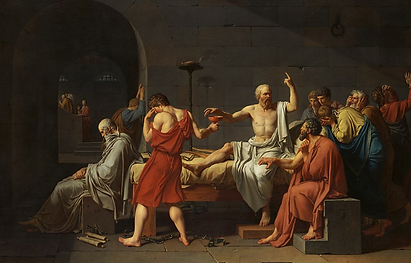

Neoclassicism (circa. 1750 - 1830s)
Neoclassicism was an art movement that emerged in the mid-18th century as a reaction to the extravagance and emotion of the Baroque styles.
This period coincided with what is referred to as the Age of Enlightenment, which was an intellectual and philosophical movement beginning in Europe. It emphasized reason, science, individualism, and human progress over tradition, superstition, and unquestioned authority.
Enlightenment thinkers admired Ancient Greece and Rome as civilizations that valued reason, democracy, law, and civic virtue—all central Enlightenment ideals. Neoclassicism, in turn, visually revived these classical forms, for example:
-
Art and architecture became orderly, balanced, and logical;
-
Artists aimed for clarity of composition and harmony, reflecting Enlightenment emphasis on reason and structure;
-
Sculptures and paintings often depicted philosophers, democratic leaders, and heroic acts of virtue, echoing Enlightenment values.
Famous painters during this period included:
-
Jacques-Louis David;
-
Jean-Auguste-Dominique Ingres
Romanticism (circa. 1800–1850s)


Romanticism was an artistic, literary, and intellectual movement that emerged in Europe at the end of the 18th century, largely as a reaction to the Enlightenment and Neoclassicism.
While the Enlightenment emphasized reason, order, and rationality - Romanticism celebrated emotion, individuality and nature.
Romantic art is typified by expressive feelings as opposed to logic. The natural environment took on greater importance with depictions of vast mountains, violent storms, or serene landscapes.
Romantics valued personal experience and often celebrated the misunderstood genius, the lonely wanderer, or the rebellious hero.
Unlike the classical focus on realism, Romantic artists turned toward dreams, myths, exotic cultures, and supernatural themes.
Many Romantic works explored folk tales, medieval legends, and national histories to express identity and cultural pride.
Romanticism rejected the structured rules of classical art. Brushstrokes became looser, compositions more dynamic, and themes more personal or spiritual.
Famous romantic artists included:
-
Francisco Goya;
-
Eugène Delacroix; and
-
William Turner.

Modern Art
Modern Art represents a period of radical innovation and transformation in artistic expression. Emerging in the late 19th century and continuing into the 20th, modern artists rejected classical traditions and instead explored new ideas, forms, techniques, and meanings. This was a time of rapid social, political, technological, and psychological change—and artists responded in bold, diverse, and often revolutionary ways.
Impressionism
(circa 1870 to 1890)
Impressionism was one of the most groundbreaking movements in Western art history. Emerging in France during the 1870s, it marked a radical departure from the academic traditions of the time.
Impressionist artists broke the rules of fine art to capture something more elusive: the fleeting, everyday moments of modern life, especially how light and atmosphere could transform a scene.
Rather than presenting polished historical or mythological themes, Impressionists chose contemporary subjects, painted with visible brushstrokes and vibrant, unblended colours, often working outdoors (en plein air) to directly observe the world around them.
Famous impressionist painters include:
-
Claude Monet
-
Pierre-Auguste Renoir
-
Edgar Degas
Although initially dismissed by some art critics of the time, Impressionism eventually became one of the most beloved and influential movements in art history. It opened the door to modernist experimentation and inspired movements like Post-Impressionism and Fauvism.

Post Impressionism
(circa 1886 to 1905)
Post-Impressionism refers to a diverse group of painters in the late 19th century who were inspired by Impressionism but wanted to move beyond its limitations.
While Impressionists focused on capturing fleeting moments and the play of light, Post-Impressionists sought deeper meaning—through bold colour, personal symbolism, structure, and emotion.
This movement encompasses the individual styles of some of the most innovative painters in art history, including:
-
Vincent van Gogh
-
Paul Cézanne
-
Paul Gauguin
-
Georges Seurat

Fauvism
(circa 1905 to 1910)
Fauvism was the first major avant-garde movement of the 20th century, known for its bold use of colour, simplified forms, and emotional expression.
The term Fauvism comes from the French word “fauves” meaning “wild beasts,” a nickname coined by a shocked critic who saw their radical artworks in 1905.
Though short-lived, Fauvism broke decisively from traditional painting and laid the foundation for modern expressionism and abstraction.
Famous artists of the period included:
-
Henri Matisse
-
André Derain

Expressionism
(circa 1905 to 1930s)
Expressionism was an early 20th-century art movement that emphasized emotional intensity, personal experience, and psychological depth over realism.
Artists used distorted forms, exaggerated lines, and bold colours to convey deep, often unsettling feelings such as anxiety, alienation, and spiritual longing.
Unlike movements focused on depicting the external world (like Realism or Impressionism), Expressionism was about capturing the artist’s internal state, especially during a time of widespread societal change, war, and existential questioning.
Expressionism emerged during a period of rapid industrialization, political unrest, and existential anxiety in Europe, especially in Germany and Austria arising from pre-WWI tensions and later the trauma of the war itself; and the rise of psychology (Freud, Jung), which influenced exploration of the inner self.
Well regarded Expressionist painters included:
-
Edvard Munch
-
Wassily Kandinsky

Cubism
(circa 1907 to 1915)
Cubism was one of the most revolutionary art movements of the 20th century.
Rather than portraying the world from a single viewpoint, Cubist artists deconstructed objects and reassembled them in abstract, geometric forms—allowing multiple perspectives to be seen at once.
This radical approach broke from centuries of tradition and laid the foundation for modern abstract art.
Cubism can be characterised as follows:
-
Subjects are broken into flat planes and angular shapes
-
Objects are shown from several perspectives at once
-
The background and foreground often merge
-
Early Cubism used a limited colour palette, mostly:- earth tones, grays, blacks, and ochres.
Famous cubist artists include:
-
Pablo Picasso
-
Georges Braque

Surrealism
(circa 1924 to 1940s)
Surrealism was a 20th-century avant-garde movement that sought to liberate the unconscious mind and merge dreams with reality.
Surrealism was born out of the chaos following World War I. Artists and writers sought to challenge rationality, logic, and order—embracing irrationality, absurdity, dreams, and desire instead.
Surrealist artworks typically depicts:
-
Bizarre, illogical, or fantastical scenes often drawn from dreams or the subconscious
-
Combination of unrelated objects or scenes in strange, often unsettling ways
-
Symbolism and hidden meanings
-
Automatism, that is, techniques aimed at allowing the unconscious to express itself freely—such as free drawing or writing without conscious control
-
Distortions of reality, creating impossible scenes and warped environments.
Surrealist artists include:
-
Salvador Dali
-
Max Ernst

Abstract Expressionism
(circa 1940s to 1950s)
Abstract Expressionism was the first American art movement to gain international influence.
It emphasized spontaneity, emotional intensity, and the subconscious, often through large-scale, abstract works that invited viewers to feel rather than interpret.
This movement wasn’t about painting a picture of something—it was about using the act of painting to explore the artist’s inner world.
Abstract Expressionism is often associated with:
-
Art without a recognizable subject
-
Focus on colour and form
-
Large scale artworks meant to engulf the viewer
-
Energetic and spontaneous brush strokes
-
Art as an outlet for emotion, such as, anxiety and joy
-
The process of creating as opposed to the final work
-
Uniqueness in applying a medium, such as, dripping, flinging, or slashing paint onto the surface
-
Use of non-traditional tools, for example, sticks, knives, poured or splattered paint, etc.
Famous abstract expressionist artists include:
-
Jackson Pollock
-
Willem de Kooning

Pop Art
(circa 1950s to 1960s)
Pop Art emerged in the 1950s and exploded in the 1960s as a bold, colourful response to the consumer-driven culture of the post-World War II era.
It celebrated—and simultaneously critiqued—mass media, advertising, celebrity culture, and everyday objects, bringing the imagery of popular culture into the realm of fine art.
Key Pop Art artists included:
-
Andy Warhol
-
Roy Lichtenstein

Contemporary Art
(1970s to present)
Contemporary art refers to art made from the late 20th century to the present day, reflecting the complexity, diversity, and innovation of our modern world.
Unlike earlier movements, it doesn't follow a single style or set of rules—instead, it explores individual expression, global perspectives, new technologies, and social issues.
It is the most diverse and dynamic period in art history, constantly evolving alongside changes in culture, politics, and technology.
There are a number of well known contemporary artists, including among many others:
-
Jeff Koons
-
Banksy
-
Cindy Sherman
-
David Hockney


Emotion in Art
As we touched on above, emotion plays a key role in a number of different art movements But, what exactly is the concept of emotion in art ?
In short, it refers to the way art evokes, expresses, or communicates feelings—both from the artist and to the viewer. Emotion in art is central to how we connect with and interpret creative works, regardless of the medium.
Artists often create work to express internal states—joy, sorrow, anger, peace, confusion, love, etc. This emotional content can be deliberate or subconscious.
Art has the power to trigger emotional responses in those who experience it. These reactions vary based on personal experiences, cultural background, and context. Viewers may feel moved by beauty or tragedy; unsettled by ambiguity or tension; or inspired by energy, hope, and resilience.
Artists use various tools to convey or heighten emotional effect, such as:
-
Colour: Warm colours may evoke excitement or anger; cool tones may suggest calm or sadness.
-
Composition: Chaotic arrangements may suggest turmoil; balance may evoke harmony.
-
Line and form: Jagged or aggressive lines might indicate conflict; flowing curves might suggest serenity.
-
Symbolism: Objects or themes can stand in for deeper feelings or experiences.

Emotion gives art depth, meaning, and resonance. Art isn’t just seen, it’s felt. Whether abstract or figurative, minimal or elaborate, art that stirs emotion tends to linger in the memory and engage the heart.
The History of Limited Edition Prints: A Story of Art, Rarity, and Collecting

Limited edition prints have long captured the imagination of art collectors, investors, and enthusiasts. Offering a bridge between the exclusivity of original works and the accessibility of mass production, these prints hold a unique place in the world of fine art. But how did this concept originate?
The story of limited edition prints begins with the invention of printmaking itself. In the 15th century, artists like Albrecht Dürer were among the first to create woodcuts and engravings that could be reproduced multiple times. These early prints were not initially considered "lesser" works — they were a revolutionary way for artists to share their visions with a wider audience.
At first, there was little control over the number of prints made from a single plate. Printers and publishers often created as many copies as they could, which led to some prints wearing down over time, resulting in lower-quality impressions. Artists eventually realized the need to regulate production to preserve the quality—and the value—of their work.
Artists, such as, Andy Warhol (pictured here) further pushed the boundaries in the 1960s, using screenprinting to mass-produce images but still creating signed, limited runs that became highly collectible. The distinction between "fine art print" and "reproduction" became sharper: a fine art print was seen as an original artwork in its own right, while a reproduction was simply a copy of an existing painting.
Today, limited edition prints are as popular as ever, often seen not just in traditional art forms but also in photography, digital media, and even sculpture casts. Contemporary artists like Damien Hirst and Banksy use the limited edition model both to maintain control over their work and to fuel a robust secondary market.
Collectors look for certain hallmarks: editions that are signed and numbered by the artist, certificates of authenticity, and information about the edition size. Smaller edition sizes (for example, an edition of 25 rather than 250) usually command higher prices.
Limited editions represent a fascinating balancing act between accessibility and exclusivity. They allow more people to experience and own a piece of an artist's vision, while still providing the rarity and prestige that collectors seek.


How are Limited Edition Prints made?
Prints are made in editions – an edition is a group of prints made from the same printing plate.
A limited edition print means the print run is predetermined by a fixed number of impressions on the understanding that no further impressions (copies) will be produced later.
Generally, the rarer the print the higher the price. If a print is part of a smaller edition, it will be more valuable, due to its exclusivity.
Limited edition prints are traditionally signed and numbered in pencil with the edition number on the bottom left, the title in the middle and signature on the right. For instance:- 33/150 – means it is the 33rd print in the group (edition) of 150 prints.
The first print is often the most valuable (eg. 1/150).
Apart from numbering the prints, prints can also be marked with different letters, eg. T/P, A/P, and P/P. These prints are often more valuable than the numbered ones.
Trial Proof (T/P)
While creating a print, the artist may experiment with various ideas, compositions and colours. In order to see how different ideas look, an artist creates a test print that is called a trial proof (T/P).
Given trial proofs are printed only once, every trial proof is one of a kind and in that sense original and highly sought after for their rarity.
Artist’s Proof (A/P)
While printing, plates tend to suffer wear and tear. During a print run the artist may pull a print from the edition to check the state of the printing. These are referred to as artist’s proofs. A/Ps are not returned to the edition but are kept by the artist for their own personal collections.
Since artists only pull a small fraction of the prints from the edition for checking (typically no more than 10%), these A/Ps are considered to be more exclusive (and more valuable) than regular prints.
Printer’s Proof (P/P)
Printer’s proofs are prints given to printers as gifts. They look exactly the same as any other print in the edition, except that they are labelled with P/P. The number of P/Ps depends on the number of printers involved in the printing process as every printer gets one proof. Since there’s usually just a few printers involved, printer proofs are typically even more exclusive than the artist’s proofs.
What is Watercolour Painting?
Watercolour painting involves artists using dry colour pigments that are suspended in a water-based solution, as opposed to say linseed oil (which is used in oil painting). Artists typically use specialised watercolour paper (which generally helps with absorption) to aide in ensuring a satisfactory finish to the art work.
History of Watercolour Painting
Watercolour paintings have probably been with us ever since man was able to create an image of their outside environment. Consider cave drawings as an example, created using red earth mixed with water.
However, as a recognised art form, the use of watercolours came into prominence during the renaissance period of the 15th and 16th centuries, particularly in Europe. During this time watercolours were often used for sketching, botanical illustration and wildlife illustration.
Artists often used watercolours to recreate their surroundings, wildlife and plants discovered during explorations in the 18th century.
Watercolour painters around the 18th century had to make paints themselves using pigments purchased from an apothecary and mixing them with gum arabic or some other binder.
Watercolour painting continued to increase in popularity as did technology around this medium. Today there is an array of specific watercolour paper, brushes, and paint readily available in tubes for artists to use.

Joseph Mallord William Turner (1775–1851), for instance, created many watercolour paintings depicting historical, topographical, architectural, and mythological topics.
Famous Watercolour Artists
Some of the most famous watercolour painters include:-
-
Vincent Van Gogh,
-
Paul Klee,
-
Paul Cezanne,
-
William Turner,
-
Winslow Homer,
among many others.

Source: Vincent van Gogh "Meules de Blé" (1888)
Introduction
Woodblock printing is a traditional technique used to create artistic prints by carving images into wooden blocks. This method has been employed for centuries, particularly in East Asia, to produce intricate designs on paper and fabric.
Woodblock printing is a specialised art form that combines creativity with craftsmanship.
Woodblock Printing Materials
Typically, the materials used in woodblock printing include:
-
Woodblock (eg. using wood from a cherry or maple tree)
-
Carving tools (gouges and chisels)
-
Ink (water-based or oil-based)
-
Brayer (roller)
-
Printing paper (rice paper or similar)
-
Baren (hand press tool)
Woodblock Printing Process
There are a number of steps usually taken to create a woodblock print. First, the artist sketches their design on paper, which is often "rice" paper due to its absorbant quality. The artist then transfers the design onto the woodblock using carbon paper or by drawing directly.
Using carving tools, like a chisel, the artist then removes areas on the block of wood to bring out the design. The artist applies a thin layer of ink onto the block using a brayer. Paper is carefully placed over the inked block. Using a baren, pressure is applied evenly across the paper. The paper is gently peeled away from the wood block to reveal the image.
History of Etchings
Etchings as an art technique arguably first came into prominence around the 1500s in Germany. The artist, Albrecht Durer is credited with the rise of etchings as an art medium.
A number of other old Masters also produced art using Etchings, such as:- Rembrandt, Bruegel, Rubens and Goya.
How are Etchings Made?

Source: Albrecht Durer | "Knight, Death and the Devil " 1513
Source: National Museum Liverpool
The image for an etching is created on a metal plate. Typically, the metal is copper, but it can also be iron or zinc.
The plate is polished to remove all scratches and imperfections from the surface.
The metal plate is then covered with an acid resisting ground, usually varnish or wax.
The artist free hand draws through this ground with a blunt stylus (etching needle). In effect scratching away parts of the ground based on the design the artist has created.
The plate is exposed to acid in the areas where the artist has drawn. Such as, by either pouring acid over the plate or placing the plate in a container so that the acid covers the plate.
The acid eats into the lines or places that the artist has scratched away on the plate to create the design, thereby resulting in a recessed area. The depth of the line is controlled by the number of times that the artist places the metal plate into the acid bath. Longer exposure will cause deeper and wider recesses.
Once the acid treatment is complete, the artist cleans off the excess ground from the plate. The artist then applies a thick ink over the plate so that the ink makes its way into the lines and recessed area. Excess surface ink is then wiped off.
The inked metal plate is placed onto a stable flat surface. The plate is covered with a sheet of dampened paper and sometimes a soft material like felt.
The ink is forcibly transferred to the paper by a special etching press which in effect rolls over the metal plate squeezing the paper and plate together, to leave an image. When the paper is removed from the plate, an original etching is then visible.
The etching is a reverse image of that on the metal plate.
Further etchings can be created from the design on the metal plate, but the artist must re-ink the plate each time before pressing.
The etching is then signed and numbered by the artist, creating a unique limited-edition etching.
Even though there is more than one etching, each is considered an original work of art because it is not a copy of anything else.
The etching process dates back to the 16th century and used by artists, such as, Rembrandt and Turner.
History of Screenprinting
In its simplest form, screenprinting is an art technique using different stencils, ink and a screen made from fabric (eg. silk or synthetic) stretched tightly over a frame.
Screen printing (or "silk screen printing") as it is also known, was first developed in China during the Song dynasty (960–1279 AD), and subsequently adopted by other eastern and western countries.
Screenprinting as an art form became more prominent in the Western countries during the 1960s when artists, such as:- Roy Lichtenstein, Peter Blake and Andy Warhol, popularized the technique.
Andy Warhol, in particular used the method to produce colourful photo image stencils of celebrities like Marilyn Monroe.
Many other artists now use screen printing as an art form.

How are Screenprints Made?
Screenprinting is a process involving a mesh screen made of a fabric material that is tightly stretched and attached to a metal or wooden frame. The mesh has tiny holes and is usually made of polyester, nylon, silk or monofilament
A stencil design is created by the artist on the mesh screen which is impervious to ink (or paint). The stencil in effect blocks the printing ink (or paint) from passing through the mesh screen.
A blade or squeegee is then moved across the screen pushing ink (or paint) through the open apertures of the mesh screen with the result that the ink (or paint) then coats the substrate (eg. paper) that lies under the mesh screen.
The ink (or paint) that has passed through the open mesh apertures forms the printed image on the paper.
One colour is printed at a time. Several screens can be used to produce a multi-coloured image or design.
Typically, the screenprint is hand-made by the artist who creates a set of limited-edition screenprints. These are signed and numbered with the edition number on the bottom left, the title in the middle and signature on the right. For instance:- 33/150 – means it is the 33rd screenprint in the group (edition) of 150 screenprints.
A hand-made (or “pulled”) screen print is regarded as an “original hand-pulled print” because of the direct involvement of the artist. Each screenprint will be slightly different from the next.
This makes them highly collectable and valuable.
